In 1938, Dr Mark Ryan, who had joined the Irish Republican Brotherhood in Lancashire in 1865, declared in the foreword to his book ‘Fenian Memories’, that ‘next to my religion, Fenianism has been the greatest thing in my life’. Not all Irish nationalists, however, who had enthusiastically embraced Fenianism as young men remained loyal to the revolutionary cause as they got older. These men had, in Ryan’s words, become ‘nationally stagnant with advancing years’.[1] And one such man in the North East of England was Bernard McAnulty, who, between 1838 and his death in Newcastle upon Tyne in 1894, first embraced then rejected the advanced nationalism of Confederate Clubs and Fenianism for the constitutional politics of Home Rule and the Irish Parliamentary Party.
This post will explore the nationalist life of Bernard McAnulty, who ‘for more than half a century’ held ‘the foremost place amongst Irish Nationalists in the North of England’,[2] and who, in 1874, became the first Irishman elected to an English town council.[3]
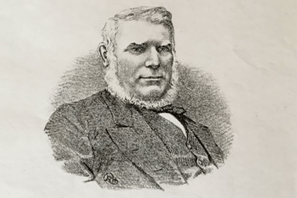
Bernard McAnulty was born in November 1818 at Burren Mills near Castlewellan, County Down, the son of a ‘substantial’ Catholic farmer and mill owner.[4] As a boy, Bernard worked both as a cattle drover between Belfast and Liverpool, and as a packman or travelling draper, before finally settling in Newcastle upon Tyne in 1838 as a linen draper.[5] Over the ensuing decades, dealing in linen, feathers, woollens, bedding, property, beer, and whiskey enabled McAnulty to amass a ‘considerable fortune’.[6]
In 1877, in his speech at a Home Rule dinner in Belfast’s Linen Hall attended by Charles Stewart Parnell, Bernard McAnulty said that he had begun ‘his career in politics under O’Connell’, but gave no further details.[7] Daniel O’Connell had visited Newcastle upon Tyne in 1835, six years after he had forced a hostile Tory government in Westminster to grant Catholic Emancipation.[8] Whilst it is not known if the teenage McAnulty was in the town that day amongst the enthusiastic crowds to greet ‘King Dan’, this may have been the event that ignited McAnulty’s nationalist politics,[9] and marked the beginning of a political career that would see him lauded in his obituaries as ‘the life and soul of all the Irish political movements in the city’, and ‘The Father of the Irish in England’.[10]
After achieving Catholic Emancipation, Daniel O’Connell sought the repeal of the Act of Union of 1800, which he blamed for the condition of Ireland, and in 1840 he founded the Loyal National Repeal Association (LNRA) in Dublin.[11] There was a branch in Newcastle by 1842, and Bernard McAnulty was an early member.[12] He was also, probably, one of Newcastle’s Repeal Rent collectors appointed at a meeting held in the Irish Harp inn,[13] as his name appears in The Nation, the Repeal movement’s newspaper, for having forwarded money to Dublin.[14] From newspaper reports of LNRA meetings, however, McAnulty does not appear to have been chairman of the Newcastle branch at this time, as his obituary later claimed.[15]
As O’Connell’s health deteriorated and famine worsened in Ireland, members of the advanced nationalist Young Ireland movement rejected O’Connell’s insistence on moral force to achieve Repeal, seceded from the LNRA, and planned rebellion. In January 1847, the militant Irish Confederation was formed in Dublin, and Confederate clubs soon spread to Irish centres in England and Scotland.[16]
Nothing, however, came of this. In July 1848, the planned rebellion in Ireland, betrayed by informers, crippled by poor leadership, planning, and the suspension of Habeus Corpus, fizzled out almost before it began.[17] Whilst in Britain, Crown forces – police, special constables, and soldiers – quickly quashed the possibility of any sympathetic outbreaks.
In Newcastle, local Confederates circulated a hand-bill calling a meeting on Town Moor on Sunday, 30 July. The Newcastle Guardian, however, reassured its readers that ‘their number here is exceedingly small, and there does not seem the least reason to anticipate any breach of the public peace’.[18] And that Sunday morning, even before the meeting had begun, it was condemned from the pulpit, with excommunication threatened to any who attended.[19] This, however, did not stop a ‘large mob’ gathering nightly at the bottom of Butchers Bank to hear the news from Ireland read to them. But Newcastle’s Irish remained calm, despite what the Durham Chronicle described as their having ‘a taste for sympathising with the seditious portion of their countrymen’.[20]
In his after-dinner speech in 1877, Bernard McAnulty said that he had been chairman of the ‘Young Ireland party’ in Newcastle.[21] And his obituary went further stating that in Newcastle’s Irish Institute there was an old copy of The Nation, dated 20 June 1848 (a month before the rebellion), in which a letter from McAnulty was printed, reporting the enrolling of ‘124 new members of the “Young Ireland” Confederate Club’, at a meeting held in their clubroom in the Corn Market.[22] There are, however, no mentions of McAnulty in The Nation’s lists of subscribers from Newcastle’s Confederate Club, which is puzzling if he had been its leader, rather than just a member.[23]
It was also claimed in his obituary that during the 1848 Rebellion McAnulty was given ‘the task of keeping a possible line of escape open’ for the rebel Thomas Darcy McGee, who was sent from Ireland to Glasgow ‘with some notion of rousing the Irish there’. If McGee’s task failed and he needed to escape, McAnulty had charted a boat for him at Blyth, north of Newcastle. In the event, however, McGee escaped to the United States by another route.[24] It is impossible to verify this claim, but, if it were true, then it demonstrates that by 1848 McAnulty had clearly rejected the moral force advocated by O’Connell in favour of physical force and rebellion.
During the 1850s, in the aftermath of the famine and the failure of the 1848 Rebellion, land and religious questions not Repeal dominated Irish politics.[25] Then, in March 1858, a new secret society – the Irish Republican Brotherhood or Fenians – was formed in Dublin by veterans of that failed rebellion, who pledged ‘to make Ireland an independent democratic republic’ by force of arms.[26]
But, possibly even before the first Fenian set foot in the North East of England, the first stirrings of a reviving nationalism were seen in Newcastle, when in March 1858 a public meeting was held in the town to raise funds for famine relief in Donegal. In the chair was Bernard McAnulty, whom the Catholic Telegraph described as ‘a man who is second to none in this locality for true patriotism and unostentatious charity’.[27] From this point on, Bernard McAnulty was the public face of Irish nationalism not just on Tyneside but across the North East of England.
In the early 1860s, the revival of the Repeal movement gathered pace not just in Newcastle but across the region at meetings usually chaired by McAnulty. In Blaydon, a meeting demanded the restitution of the Irish parliament;[28] in Newcastle, McAnulty told the crowded meeting that the Union had as a result of the famine ‘reduced the population of Ireland from nine millions to five millions and a half’;[29] whilst in Durham, chairman McAnulty told a meeting in the new town hall:[30]
No country had more wrong done to it than Ireland during the last twelve years… There had been an artificial famine, which had swept over the face of the country and killed thousands and thousands of people… In reality it was the union that killed the people and not the famine… If the country had been properly governed there would have been no want… The obnoxious act of union was the true seat of Ireland’s calamities.
In contrast to the Durham Chronicle’s sympathetic report, the Durham County Advertiser sneered at this meeting of ‘Irish patriots’ chaired by ‘a stout, fresh, jolly-looking Hibernian’, and ended by proclaiming that ‘Never… was the New Town Hall put to such an unworthy use’.[31]
In early 1861, a new organisation – the National Brotherhood of St Patrick (NBSP) – was formed in Dublin to promote and co-ordinate the celebration of St Patrick’s Day – the ‘National Anniversary’ – across Ireland and Britain, as ‘The Friendly Sons of St Patrick’ did annually in the United States of America.[32] The Irish in Britain were not slow to follow suit and within a year it was estimated that there were some twenty to thirty thousand NBSP members in Britain.[33] In Newcastle, a branch was formed in September 1861 and, when the branch met to discuss celebrating St Patrick’s Day in 1862, Bernard McAnulty was in the chair.[34] As he was in 1863.[35]
In April 1864, McAnulty was on the platform with others ‘distinguished for their patriotic love of fatherland’ at a NBSP meeting in Newcastle at which Christopher Clinton Hoey, the NBSP’s general secretary, described ‘the withering oppression and galling chains riveted upon unfortunate Ireland’ since the time of the Tudors, and spoke ‘in patriotic terms’ on the rebellions of 1798 and 1848.[36]
Clinton Hoey was a Fenian,[37] and from its inception, the NBSP was more than just a social club organising banquets and concerts. It was a front for the Fenians, enabling this secret revolutionary organisation to recruit new members and influence the direction of nationalist thought. Later, the Fenian John Denvir described the NBSP as being the IRB’s ‘chief recruiting ground’ in Britain.[38] And it has been claimed that the NBSP ‘laid the foundation for north-west England to develop into the best organised Fenian district in Britain, with entire local branches reborn as Fenian clubs’.[39] Was this also true of the North East of England?
In 1864, the Fenians withdrew their support from the NBSP, when James Stephens, the Fenians’ chief organiser, directed that all the Brotherhood’s energies were to be focussed on the coming rising.[40] That much-delayed rising finally began in February 1867, but betrayed by informers, lacking arms, crippled by poor leadership and coherent planning, and with many of its leaders already imprisoned, the rising was a fiasco and was easily crushed by Crown forces. At the same time, a raid by English-based Fenians on Chester Castle for much-needed arms and ammunition was abandoned before it began after an informer alerted the authorities.[41]
Though the rising had failed, the rescue of two Fenian leaders from a prison van in Manchester in September 1867 and the Fenian bomb in Clerkenwell that December demonstrated to the authorities and a nervous British public that the Irish revolutionary movement was still active.[42] And Fenian panic gripped the North East, as across the rest of Britain, with special constables recruited, the militia alerted, and volunteer armouries protected.[43]
There were perhaps some several hundred Fenians in the North East in 1867.[44] Keenly aware of the authorities’ heightened vigilance and the danger of informers, these men remained hidden and few of their names are known with any certainty. One name, however, that is known is that of Wexford-born John Barry, who was a successful Newcastle businessman.[45] Barry and Bernard McAnulty were to share many a platform over the ensuing years.
After the failure of the rising, there was little public Irish nationalist activity in the North East of England, and the St Patrick’s Day’s celebrations of 1868 were muted and centred in churches.[46][47] That nationalist voice, however, returned in late 1868 as the demand grew for the release of the Fenian prisoners.[48] And in March 1869 McAnulty told a St Patrick’s Day demonstration in Newcastle that for seven hundred years Ireland had been ‘the victim of Anglo-Saxon tyranny’ and was now ‘the poorest, the most oppressed, and enslaved country in the world’, and that that would only change when Ireland had a government ‘responsible… to the Irish people’.[49] McAnulty as chairman and Barry as secretary had organised this demonstration with proceeds sent to an amnesty fund in Dublin.[50]
In June 1869, the Amnesty Association was formed in Dublin to co-ordinate meetings and demonstrations, and, from the first, it was dominated by members of a revitalised Irish Republican Brotherhood.[51] Organised by John Nolan, the Association’s general secretary and a member of the IRB’s newly-formed Supreme Council,[52] a series of outdoor meetings were held across Ireland that autumn, culminating in a meeting on 10 October of some 100,000 people at Cabra, near Dublin. Two weeks later, on Sunday 24 October, an amnesty meeting in Newcastle attracted an estimated 20,000 people.[53] According to the Newcastle Journal, crowds wearing green scarfs, favours and rosettes travelled to Town Moor from both sides of the Tyne to be greeted with placards demanding ‘Justice, open the prison doors, and set the captives free’. The advertisements for this event had given the organisers’ address as the Portland Hotel in Newcastle. This hotel was owned by McAnulty,[54] and McAnulty took the chair on the day. With him on the platform was John Barry, who, like John Nolan, was also then a member of the IRB’s ruling Supreme Council.[55]
McAnulty took the chair again that December, when a ‘national entertainment’ was held in Newcastle’s town hall ‘for the benefit of the wives and families of the political prisoners’. In his speech, McAnulty described the plight of the prisoners ‘wasting their best days in a British dungeon’, and appealed on behalf of their ‘starving families’. At the concert’s close, the band played ‘God Save Ireland’, and the audience stood and cheered. John Barry had been one of the concert’s two organising secretaries,[56] and noticeable among the agents selling tickets for the event was ‘Mr Savage, fruiterer, Clayton Street’.[57] This was Edward Savage, who had given sanctuary in 1867 to his nephew, after he had fled Ireland as a hunted Fenian.[58]
In spite of the release and expulsion from Ireland in early 1871 of several Fenian leaders, the campaign for a full amnesty continued, and in 1872 demonstrations were held across the North East in Middlesbrough,[59] Sunderland,[60] Bishop Auckland,[61] Consett,[62] Stockton on Tees,[63] and Newcastle.[64] For the Newcastle demonstration, where, it was estimated, up to 40,000 people were present, crowds travelled by train from across Tyneside and were marshalled outside Central station. Most of the crowds, noted the newspapers, were ‘of the Irish labourer type’, with many from the ‘mysterious passages and closes’ of Newcastle’s Sandgate and from ‘the least desirable regions of Shields’. Also present, however, were men who could ‘afford to appear in tall hats and broad cloth’. At two o’clock, the exuberant crowds set off behind bands and banners to march to Town Moor, where three carts had been set up as platforms. Bernard McAnulty was elected chairman and, in his speech, demanded that ‘the prison doors shall be thrown open and the prisoners set free’. Among the speakers that afternoon were John Barry and John Nolan. Both were sworn members of a secret revolutionary organisation, yet had become deeply engaged in public life and constitutional nationalist politics.
This was the result of the IRB’s Supreme Council acknowledging in January 1870 that there was no possibility of another rising in the foreseeable future; accepting that some Fenians were already involving themselves in constitutional politics; and agreeing a new policy of encouraging Fenians ‘to obtain control of all local bodies such as corporations… as a means of increasing the power and influence of the Irish Republic’.[65] And in Newcastle, John Barry took this as official Fenian endorsement of the policy he was already practising.
In December 1870, there was a meeting of Newcastle’s Catholic voters to discuss the forthcoming School Board election.[66] Barry was present and said that he had attended two previous, consultative meetings held in St Mary’s cathedral and St Andrew’s church, at which he had proposed Bernard McAnulty as the lay candidate. McAnulty, however, had been rejected, and Barry asked if Newcastle’s Catholic voters were going to ‘permit their clergy to think and act for them’, adding that McAnulty had been rejected ‘on account of his Fenian proclivities’. Father Perrin from the Cathedral then reiterated the Fenian ‘accusation’ against McAnulty, prompting a shout from the floor ‘No, he is not a Fenian; he is an excellent Catholic’. McAnulty, however, was not chosen as the lay candidate.
Meanwhile in Dublin in May 1870, Isaac Butt, the Protestant MP and president of the Amnesty Association, formed the Home Government Association (HGA) to mobilise and influence public opinion.[67] Before the HGA’s formation, Butt, who had defended Fenian prisoners in court, may have been promised ‘benevolent neutrality’ by the IRB’s Supreme Council. Fenians would not, therefore, oppose or disrupt the burgeoning Home Rule movement, and progressive Fenians like Barry and Nolan welcomed this opportunity for action, believing that their involvement in constitutional politics and the influence they could wield would advance the cause of Irish independence.
In January 1872, Bernard McAnulty, who had been admitted to the HGA in Dublin a few months earlier,[68] chaired a meeting in Newcastle to discuss forming a Home Rule Association in the town. Amongst the speakers and guests on the platform were local priests and John Barry.[69] The new branch was formed in Newcastle’s Irish Literary Institute, and McAnulty was unanimously elected president.[70] Discussions at subsequent Association meetings centred on the importance of registering the town’s Irish voters, and the need for more Irishmen to be nominated for ‘public positions, in order that they might better serve the interests of their countrymen’.[71]
In early 1873, John Barry, who by then was living and working in Manchester, co-founded with John Ferguson the Home Rule Confederation of Great Britain (HRCGB) to co-ordinate, and thus control, the newly-formed Home Rule Associations in Britain.[72] That August, the Confederation’s first general meeting was held in Newcastle’s town hall with Isaac Butt and some two hundred delegates in attendance, and agreed to empower an executive to direct the Irish vote in English parliamentary constituencies.[73] After this private meeting, a public event was held that evening with Bernard McAnulty in the chair. Notable amongst the long lists of names present that day were four members of the IRB’s eleven-man Supreme Council: John Barry, an honorary member; John Walsh of Middlesbrough, joint representative for the North of England;[74] William McGuinness of Preston, joint representative for the North of England; and John O’Connor Power, Connacht’s representative. John Ferguson was also on the platform, who, if not then a sworn member of the Brotherhood, was a fellow traveller.[75]
Bernard McAnulty’s association with the IRB’s leadership did not end there. At a joint Amnesty and Manchester Martyrs demonstration in Dublin in November 1873, McAnulty shared a platform with John Barry and five other members of the Supreme Council.[76]
November 1873 also saw the Home Government Association reconstituted at a convention in Dublin as the Home Rule League. This was intended to be a mass movement, as the HRCGB was becoming in Britain, and it has been suggested that John Barry and John Ferguson were behind its creation.[77] Five members of the IRB’s Supreme Council attended this convention, and, when a committee was appointed to establish the new League under Isaac Butt’s leadership, two of its members were from the Supreme Council, John Barry and Joseph Gillis Biggar. Trustees were also appointed under the chairmanship of the Archbishop of Tuam to oversee the League’s funds. One of the new trustees was Bernard McAnulty.[78]
Branches of the Home Rule Confederation of Great Britain were soon formed across the North East of England,[79] and first flexed their electoral muscles in the 1874 general election. In Durham, the two Liberal candidates spoke to the branch in support of Home Rule and were rewarded with Irish votes.[80] Whilst in Newcastle, the branch agreed to support the Liberal candidate, Joseph Cowen, whose Newcastle Chronicle newspapers supported Home Rule.[81]
In Bedlington, where a branch had only been formed in late January 1874, delegates met the Liberal candidate for the Morpeth constituency, Thomas Burt, secretary of the Northumberland Miners’ Association, and asked him if he would ‘vote for Home Government for Ireland and the release of the political prisoners’.[82] Burt agreed and the branch declared their support for him. On Thursday 5 February, the day of the election, Irish voters assembled at noon and then marched off to vote led by a brass band playing ‘Irish national airs’. And each man was seen to be ‘wearing a green and white rosette and a large green card in the front of his hat with the inscription, in large and prominent letters “Vote for Burt, Home Rule, and Amnesty”’. Blyth’s Irish voters similarly marched behind a brass band to cast their votes. Burt was elected and The Flag of Ireland newspaper claimed that the Irish votes had ‘contributed materially’ to Burt’s victory.
Irish votes were again in evidence in November 1874, when Bernard McAnulty, as president of the Newcastle branch of the HRCGB, stood as an Irish nationalist and Home Rule candidate in Newcastle’s council elections and was returned for the East All Saints’ Ward, which included the Irish enclave of Sandgate, with a majority of twenty-two votes.[83] And thus became the first Irishman to be elected to an English town council; a seat he held until 1882.[84]
By early 1876, there were ninety-five active branches of the HRCGB, with thirteen in the North East of England.[85] And the HRCGB’s executive, of which John Barry was honorary secretary, was boasting that the confederation had ‘cut the bonds by which the Irish people were tied to the cart-tail of the Liberal party… The Irish people are no longer regarded as the tools of English politicians. They stand alone… directing all their efforts to secure Home Rule for Ireland’.[86]
Though the Home Rule movement in Ireland and Britain had made progress, it had manifestly failed to achieve its primary objective, whilst, at the same time, in the view of the orthodox members of the IRB’s Supreme Council, was damaging the integrity of the Brotherhood. In August 1876, therefore, the Supreme Council agreed, by a majority of one vote, that all Fenians should withdraw from active cooperation with the Home Rule movement within six months.[87] And by March 1877, four members of the Supreme Council, including John Barry, had been expelled for failing to comply with this order.
How many Fenians in England left the organisation after this vote is not known, but one historian has argued that ‘Fenianism in England and Scotland was inextricably identified with the Home Rule Confederation of Great Britain’,[88] and, so, it is very likely that many followed John Barry out of the IRB to continue their active and very public association with constitutional politics.[89] Councillor McAnulty may have been one of those to supress his ‘Fenian proclivities’ and follow Barry, especially as he had also been elected to Newcastle’s School Board and the Board of Guardians.[90]
At the HRCGB’s convention in Liverpool in August 1877, at which McAnulty was present, Charles Stewart Parnell, on a motion of John Barry, was elected president in place of Isaac Butt, after delegates had demanded ‘a more active and vigorous policy’ from Irish MPs in Parliament.[91] And in September, as part of his extensive tour of the north of England and Scotland to promote the obstructionist tactics adopted by Irish MPs, Parnell spoke in Middlesbrough. McAnulty was in the chair, and in his opening remarks fulsomely praised what he described as ‘a new era arising in the politics of Ireland’ under the leadership of Parnell.[92]
A week later, McAnulty was in Belfast’s Linen Hall for a Home Rule dinner attended by Parnell. There McAnulty, after giving a resume of his nationalist life, said that he had more faith in Parnell and the other Irish nationalist MPs ‘and the policy which they had adopted, than in all the movements Ireland had ever followed’.[93] Here, McAnulty was very publicly not simply supressing but denying his ‘Fenian proclivities’.
Close study of contemporary newspapers of the late 1870s and 1880s, reveal that Bernard McAnulty totally dominated Irish nationalist activity in the North East of England, and few meetings or demonstrations of the HRCGB, and its successors the Land League and the Irish National League of Great Britain, took place without his being in the chair. And, at many of these events, both public and private, McAnulty met Parnell and endorsed his leadership.[94]
During these years, there must have been few Irish nationalists of any note that McAnulty did not meet or share a platform with in Dublin, Liverpool, London, or the North East of England. As well as John Barry, who was elected MP for County Wexford in 1880, there were John O’Connor Power and Joseph Gillis Biggar, both of whom had been elected as MPs whilst members of the IRB’s Supreme Council;[95] Isaac Butt;[96] Michael Davitt, the former Fenian and founder of the Land League;[97] Justin McCarthy;[98] T.P. O’Connor;[99] William O’Brien;[100] and John Redmond.[101] And when Anna Parnell addressed branches of the Ladies Land League in Newcastle and Jarrow, McAnulty was in the chair.[102]
In late November 1890, the revelations from the O’Shea’s divorce prompted a leader in Newcastle’s Irish Tribune to conclude: ‘What all the enemies of Ireland failed to do against Mr Parnell, he has done for himself’.[103] Across the North East of England, INLGB branches met to discuss the crisis facing the Irish Parliamentary Party and the cause of Home Rule, and in March 1891 delegates from over seventy branches gathered in Newcastle’s Irish Literary Institute. In the chair was 73-year-old Bernard McAnulty, and, when the vote was taken on a resolution condemning Parnell and calling on him to resign, there was only one dissenting voice, and it was not McAnulty’s.[104]
In late 1892, the aging McAnulty revealed just how far he had become ‘nationally stagnant’, when he proposed a toast to ‘The Queen’, during the Irish Literary Institute’s twenty-first anniversary dinner in Newcastle, attended by past and current members, including the MPs John Barry, Timothy Healy, and Charles Diamond.[105]
Yet, a spark of his younger self still remained. In November 1893, Parnellites planned a mass Amnesty demonstration in Newcastle, with speakers, including John Redmond and Maud Gonne. This was to be the biggest Amnesty demonstration on Tyneside since 1876, and McAnulty, though an ardent anti-Parnellite, but whose ‘name has been a household word in the North of England for two generations’, was invited to be chairman, as he had been in 1876.[106] McAnulty accepted, but, in the event, he was ill and was unable to attend the demonstration.[107]
Bernard McAnulty died on Sunday 9 September 1894, at his home in Claremont Place, Newcastle upon Tyne, and, after a requiem mass in St Andrew’s church, was buried in Jesmond cemetery. He was 76-years-old.[108]
Though McAnulty’s obituary denied that he had ever been an active Fenian,[109] the Fenian John Denvir remembered McAnulty as a ‘most active and enthusiastic colleague’ and, echoing Barry’s portrayal, ‘a man of advanced proclivities’, adding:[110]
In connection with the Fenian movement my dear old friend was a strong, active, and generous sympathiser. His purse was always available for every good National object, whether “legal” or “illegal,” and I know as a fact that many a good fellow “on the run” found shelter under his roof, and never went away empty-handed.
Although T.P. O’Connor called McAnulty a champion of ‘constitutional agitation’, and the leader of ‘quite respectable societies’,[111] he also described Tyneside as having been ‘honeycombed with Fenians’ before the Rising of 1867, and added that:
Many a hunted Fenian… found welcome and safe hiding… in the fine house of a well-to-do compatriot, whose worldly success, wealth, and high social standing, put him above all suspicion of Fenian sympathies.
So, whilst Bernard McAnulty -‘The Father of the Irish in England’- may never have ‘spent half the night in dark cellars, planning, organising, and getting the “stuff”’ (arms and ammunition),[112] he was more than just a Fenian sympathiser, more than just a fellow traveller, and, almost certainly, had once sworn an oath of allegiance to ‘the supreme council of the Irish Republican Brotherhood and government of the Irish Republic’.[113]
Note: The drawing of Bernard McAnulty above is probably based on a photographic portrait taken by Mendelssohn of Newcastle and presented to McAnulty by the Mayor of Newcastle at a dinner in his honour in the Queens’ Head Hotel in 1878.[114]
[1] Dr Mark F. Ryan, Fenian Memories (Dublin 1946, 2nd ed), pp. xxiii, 209.
[2] From the tribute to Bernard McAnulty held at Newcastle’s Irish Literary Institute. Newcastle Weekly Chronicle, 15 September 1894.
[3] Joan Allen and Richard C. Allen, Competing Identities: Irish and Welsh Migration and the North East of England, 1851-1980, in Adrian Green and A.J. Pollard, Regional Identities in North East England, 1300-2000 (Woodbridge, 2007), p.146.
[4] The Flag of Ireland, 22 May 1875; a ‘Hugh M’Anulty’ owned a flax mill at Drumgooland near Castlewellan in 1796. Flax Growers of Ireland 1796, County Down. https://www.failteromhat.com/flax/down.htm
[5] Bernard McAnulty is noted on the 1841 Census as a draper living with other Irish drapers in Dog Leap Stairs, Newcastle upon Tyne. G.F. Duffy. The Rise of the Irish Working Class in North East England’, in Northern Catholic History, No.57, 2016; Newcastle Weekly Chronicle, 15 September 1894; United Ireland, 15 September 1894.
[6] In 1865, Newcastle magistrates granted McAnulty a licence for a ‘beer house’. Newcastle Weekly Chronicle, 9 September 1865; in 1894, McAnulty was given permission by Newcastle County Court to evict a tenant from a house he had owned for 18 years. Newcastle Weekly Chronicle, 15 September 1894; The Flag of Ireland, 22 May 1875.
[7] Freeman’s Journal, 28 September 1877.
[8] See my earlier post: ‘Daniel O’Connell in Newcastle, 1835’, https://exilesinengland.com/2020/10/31/962/
[9] At the Belfast dinner in 1877, McAnulty claimed that he had been a member of O’Connell’s Precursor Society that had foreshadowed the LNRA. This society met between 1838 and 1839, but there is no evidence of a branch in Newcastle other than for McAnulty’s claim. For the Precursor Society, see Patrick M Geoghegan, Liberator: The life and death of Daniel O’Connell 1830-1847 (Dublin, 2012), pp.106-8.
[10] Newcastle Weekly Chronicle, 15 September 1894; United Ireland, 15 September 1894.
[11] Geoghegan, Liberator, p.115.
[12] He was named as ‘Bernard M’Aleenan’. Freeman’s Journal, 14 December 1842.
[13] The Nation, 22 October 1842.
[14] He was named as ‘Bernard M’Alenan’. The Nation, 14 October, 18 November, & 16 December 1843.
[15] In 1842, Peter M’Dude/Dade chaired the repeal meeting in the Irish Harp inn. The Nation, 22 October 1842; in 1844, Thomas M’Nally was Newcastle’s ‘Repeal Warden’. The Nation, 29 June 1844; Newcastle Weekly Chronicle, 15 September 1894.
[16] In Liverpool, for example, 23 Confederate clubs have been identified. John Belchem, Irish, Catholic and Scouse. The History of the Liverpool-Irish, 1800-1939 (Liverpool, 2007), p.159.
[17] James S Connelly ‘A famine in Irish politics’ in W.E. Vaughan (ed.), A New History of Ireland, v, Ireland under the Union, 1801-70 (Oxford,1989, reprinted 2007), pp.368-9.
[18] Newcastle Guardian, 29 July 1848.
[19] Durham Chronicle, 4 August 1848.
[20] Ibid.
[21] Freeman’s Journal, 28 September 1877.
[22] United Ireland, 15 September 1894; in his book, The Irish in Britain (London, 1894), p.140, John Denvir wrote that McAnulty called this Confederate Club the ‘No.1 Newcastle-upon-Tyne Felon Repeal Club’. Note there was a ‘Felon’s Hope’ Confederate Club in Liverpool in 1848. Belchem, Irish, Catholic and Scouse, p.161.
[23] The Nation, 1 May, 31 July, & 23 October 1847.
[24] United Ireland, 15 September 1894.
[25] D. George Boyce, Nationalism in Ireland (2nd edition, London, 1991), pp.176-7.
[26] Oath taken by the IRB’s founders, quoted by E. R. R. Green, ‘The Beginnings of Fenianism’, in T.W. Moody (ed.), The Fenian Movement (Dublin, 1968), p.17.
[27] McAnulty gave ten shillings to the fund. Catholic Telegraph, 27 March 1858.
[28] North and South Shields Daily Gazette, 20 September 1860.
[29] Catholic Telegraph, 1 December 1860.
[30] This report from the Durham Chronicle of 18 January 1861 was reprinted abridged in The Irishman and in full in The Nation on 26 January 1861.
[31] Durham County Advertiser, 18 January 1861.
[32] The Irishman, 26 January 1861. Also, see my earlier post: https://exilesinengland.com/2023/11/28/ours-cannot-be-a-secret-society-the-national-brotherhood-of-st-patrick-in-newcastle-upon-tyne-1861-1864/
[33] Mervyn Busteed, The Irish in Manchester c.1750-1921 Resistance, adaptation and identity (Manchester, 2016), p.125. Also Gerard Moran, ‘Nationalists in exile: the National Brotherhood of St Patrick in Lancashire, 1861-5’, in R. Swift and S. Gilley (eds), The Irish in Victorian Britain: the local dimension (Dublin, 1999), pp.212-35.
[34] Newcastle Daily Chronicle, 22 March 1862.
[35] Newcastle Chronicle and Northern Counties Advertiser, 21 March 1863.
[36] Glasgow Free Press, 30 April 1864.
[37] Christopher Clinton Hoey (c.1831-1885) was The Irishman’s London correspondent. Elizabeth Tilley, The Periodical Press in Nineteenth-Century Ireland (Cham, Switzerland, 2020), pp.102-4.
[38] Denvir, The Irish in Britain, pp.178-9.
[39] Busteed, The Irish in Manchester, p.209. Also, William J. Lowe, ‘Lancashire Fenianism, 1864-71’, Transactions of the Historical Society of Lancashire and Cheshire, 126 (1976), pp.156-85.
[40] Marta Ramón, ‘National Brotherhoods and National Leagues: The IRB and its Constitutional Rivals during the 1860s’, in Fearghal McGarry and James McConnel (eds.) The Black Hand of Republicanism Fenianism in Modern Ireland (Dublin, 2009), p.30.
[41] Patrick Quinlivan and Paul Rose, The Fenians in England 1865-1872 (London, 1982), pp.16-24.
[42] R.V. Comerford, The Fenians in Context. Irish Politics & Society 1848-82 (Dublin, 1998), pp.148-50.
[43] Newcastle Daily Journal, 25 November 1867; in Durham 300 special constables were appointed in early January 1868. Durham Chronicle, 10 January 1868.
[44] In July 1874, an IRB conference in Manchester was told that their North of England division had some 4,000 members. How many of these Fenians lived on Tyneside rather than Liverpool or Manchester was not recorded. T.W. Moody and Leon Ó Broin, ‘IRB Supreme Council, 1868-78’, Irish Historical Studies, 19.75 (1975), p.332.
[45] C.J. Woods, ‘John Barry’, Dictionary of Irish Biography, https://www.dib.ie/biography/barry-john-a0445
[46] Newcastle Daily Journal, 18 March 1868.
[47] South Shields Daily Gazette, 19 March 1868.
[48] ‘A few patriotic Irishmen of Spennymoor’ sent a donation to Dublin for ‘the families of the state prisoners’. The Irishman, 26 December 1868.
[49] Newcastle Courant, 19 March 1869.
[50] The Nation, 27 March 1869.
[51] R.V. Comerford, ‘Gladstone’s first Irish enterprise, 1864-70, in W.E. Vaughan (ed.), A New History of Ireland, v, Ireland under the Union, 1801-70 (Oxford,1989, reprinted 2007), pp.446-7.
[52] Owen McGee, ‘John (Amnesty) Nolan’, Dictionary of Irish Biography, https://www.dib.ie/biography/nolan-john-amnesty-nolan-a6220
[53] Newcastle Daily Journal, 25 October 1869. The Freeman’s Journal estimated 20,000 to 40,000 attendees. Freeman’s Journal, 27 October 1869.
[54] Newcastle Daily Journal, 22 November 1866; The Flag of Ireland, 23 October 1869.
[55] Moody & Ó Broin, ‘IRB Supreme Council, 1868-78’, pp.294-5, 328.
[56] The Flag of Ireland, 8 January 1870.
[57]The Flag of Ireland, 11 December 1869.
[58] See my earlier post: ‘Fenian Revolvers in Newcastle, 1870’, https://exilesinengland.com/latest-post/page/2/
[59] Freeman’s Journal, 24 October 1872.
[60] The Irishman, 2 November 1872.
[61] The Irishman, 16 November 1872.
[62] Ibid.
[63] Daily Gazette for Middlesbrough, 16 December 1872.
[64] The Irishman, 2 November 1872. Also, Roger Cooter, When Paddy Met Geordie: The Irish in County Durham and Newcastle, 1840-1880 (Sunderland, 2005), p.157.
[65] Moody & Ó Broin, ‘IRB Supreme Council, 1868-78’, p.310.
[66] There were only 600 Catholic voters in Newcastle at the time. Newcastle Daily Journal, 10 December 1870.
[67] Comerford, The Fenians in Context, pp.188-89. Also, Philip Bull, ‘Isaac Butt’, Dictionary of Irish Biography, https://www.dib.ie/biography/butt-isaac-a1311
[68] Dublin Evening Mail, 3 October 1871.
[69] The Irishman, 13 January 1872.
[70] The Irishman, 25 May 1872.
[71] The Nation, 30 November 1872.
[72] Owen McGee, The IRB: The Irish Republican Brotherhood from the Land League to Sinn Féin (Dublin, 2005), p.47.
[73] There were HRCGB branches in Blaydon, Blyth, Consett, Durham, Felling, Gateshead, Jarrow, Middlesbrough, Newcastle, Scotswood, South Shields, and Sunderland. The Irishman, 30 August 1873.
[74] See my earlier post: ‘John Walsh: Middlesbrough’s Invincible’, https://exilesinengland.com/2022/04/30/john-walsh-the-invincible/
[75] John Ferguson, an Ulster Protestant businessman, was a key figure in Glasgow’s Irish nationalist politics. E.W. McFarland, John Ferguson, 1836-1906, Irish issues in Scottish politics (East Linton, East Lothian, 2003), pp.33-5.
[76]Freeman’s Journal, 24 November 1873. The six members of the Supreme Council were John Barry; John Walsh; William McGuinness; John O’Connor Power; plus Joseph Gillis Biggar, honorary member; and Charles Guilfoyle Dornan, Munster’s representative and the Council’s secretary. See Moody & Ó Broin, ‘IRB Supreme Council, 1868-78’, p.292.
[77] Mcgee, The IRB, p.47.
[78] Morning Post, 22 November 1873.
[79] For example, in Blyth, Darlington, Gateshead, Jarrow, Sunderland, South Shields, and Durham. The Flag of Ireland, 3, 17 & 24 January 1874.
[80] The Flag of Ireland, 24 January 1874.
[81] Joan Allen, Joseph Cowen and Popular Radicalism on Tyneside 1829-1900 (Monmouth, 2007), pp.92-3.
[82] The Flag of Ireland, 21 February 1874.
[83] The Flag of Ireland, 28 November 1874.
[84] Joan Allen and Richard C. Allen, Competing Identities: Irish and Welsh Migration and the North East of England, 1851-1980, in Adrian Green and A.J. Pollard, Regional Identities in North East England, 1300-2000 (Woodbridge, 2007) p.146.
[85] The active HRCGB branches were in Bedlington, Bishop Auckland, Blyth, Coundon, Durham, Hexham, Houghton le Spring, Jarrow, Middlesbrough, Newcastle (No 1 branch), Prudhoe, Sunderland, and Wylam. The Flag of Ireland, 25 March 1876.
[86] The Flag of Ireland, 29 January 1876.
[87] Leon Ó Broin, Revolutionary Underground: The Story of the Irish Republican Brotherhood, 1858-1924 (Dublin, 1976), p.10-12.
[88] Comerford, The Fenians in Context, p.255.
[89] In April 1880, Barry was elected MP for County Wexford. Woods, ‘John Barry’, https://www.dib.ie/biography/barry-john-a0445
[90] McAnulty received 14,372 votes. Canon Drysdale topped the poll with 15,143 votes. Newcastle Weekly Courant, 19 January 1877; McAnulty was elected for the All Saints Parish with 648 votes. Newcastle Weekly Courant, 13 April 1877.
[91] Freemans Journal, 28 August 1877.
[92] Weekly Gazette (Middlesbrough), 15 September 1877.See Neil C. Fleming and Alan O’Day, Charles Stewart Parnell and his times. A Bibliography (Oxford, 2011), p.107.
[93] Freeman’s Journal, 28 September 1877.
[94] For example, in August 1880, after the HRCGB convention in Newcastle, McAnulty presided at a dinner for Parnell and the delegates. Sunderland Daily Echo, 10 August 1880.
[95] Weekly Gazette (Middlesbrough), 15 September 1877.
[96]The Flag of Ireland, 26 August 1876.
[97] Freeman’s Journal, 1 December 1879.
[98] Sunderland Daily Echo, 10 August 1880.
[99] Freeman’s Journal, 18 April 1881.
[100] Morpeth Herald, 19 July 1890.
[101] Freeman’s Journal, 14 August 1882.
[102] Newcastle Courant, 9 September 1881; Jarrow Express & Tyneside Advertiser, 23 December 1881.
[103] Irish Tribune, 22 November 1890.
[104] Northern Echo, 23 March 1891.
[105] Freeman’s Journal, 3 January 1893.
[106] United Ireland, 11 November 1893.
[107] United Ireland, 18 November 1893.
[108] Newcastle Weekly Courant, 15 September 1894.
[109] United Ireland, 15 September 1894.
[110] John Denvir, The Life Story of an Old Rebel (Dublin, 1910), p.56.
[111] T.P. O’Connor, ‘The Irish in Great Britain’ in Felix Lavery (compiler), Irish Heroes in the War (London, 1917), p.46.
[112] Ibid., p.49.
[113] ‘Amended Constitution of the I.R.B. and of the Supreme Council’, 17 March 1873, in Moody & Ó Broin, ‘IRB Supreme Council, 1868-78’, p.314.
[114] The Irishman, 1 June 1878. This drawing has previously been used to illustrate G.F. Duffy, ‘The rise of the Irish Working Class in North East England’, in Northern Catholic History, 57, 2016; and a Tyneside Irish Centre piece https://tynesideirish.com/projects/irish-centres-150th-anniversary/
 exiles in england